Blastify: AI-Driven WhatsApp Marketing & CRM SaaS
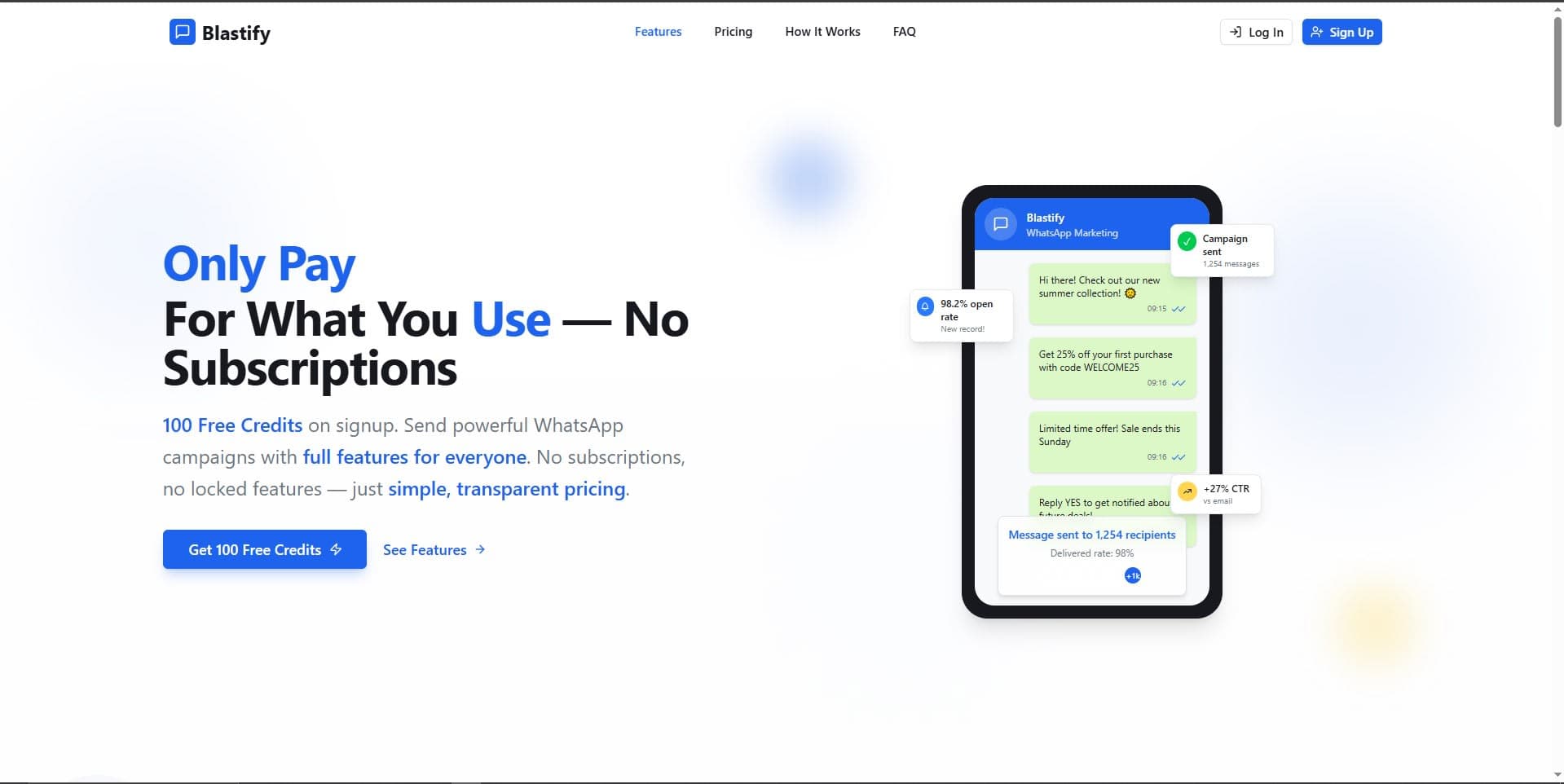
Blastify (AI-Driven WhatsApp Marketing & Automation Engine)
1. Problem
Businesses needed a cost-effective way to send high-volume WhatsApp marketing campaigns and transactional notifications. However, using official APIs is strictly templated and expensive, while naively using unofficial WhatsApp APIs results in instant permanent number bans due to algorithmic spam detection (sending identical message payloads too rapidly). Furthermore, existing systems lacked a programmatic way to trigger these messages from external platforms (like custom CMS or POS systems).
2. Solution
Architected a headless, API-first WhatsApp automation engine with a Next.js management dashboard. To completely bypass spam detection, I implemented a robust message queuing system with intelligent batching (introducing human-like delays/jitter) and integrated an AI-driven paraphrasing engine that dynamically rewrites message variations on the fly.
3. Architecture
- Frontend Dashboard: Next.js (React)
- API & Automation Engine: Node.js + Express.js
- Message Queue & Scheduling: Redis + BullMQ (or similar queue processor)
- Core Integration: Unofficial WhatsApp Web Client Library + AI API (for paraphrasing)
- Database: PostgreSQL (for campaign tracking, API keys, and contact lists)
4. Key Engineering Decisions
- API-First Architecture: Designed the core engine entirely as a REST API. The Next.js dashboard is simply one consumer of this API. This allowed seamless, immediate integration with external platforms, such as the Sasuai App, which uses Blastify as a microservice for membership notifications.
- AI Message Paraphrasing: Standard spam filters trigger when thousands of identical string hashes are sent simultaneously. By passing the base message through an AI prompt before dispatching, the system generates unique conversational variations (e.g., changing greetings or sentence structures) while maintaining the core intent, successfully breaking the spam detection pattern.
- Asynchronous Queue Dispatching: Absolutely zero messages are sent synchronously via HTTP requests. Every blast or scheduled message is pushed to a background worker queue, which strictly controls the dispatch rate (batching) and enforces mandatory delays between executions.
5. Challenges
- Session Persistence: Managing the volatile nature of unofficial WhatsApp web sessions (handling remote QR code authentication, connection drops, and automatic reconnections) within a headless Node.js environment.
- Rate Limiting Mathematics: Finding the precise mathematical threshold for batching and delays to maximize campaign throughput without crossing the threshold that triggers algorithmic bans.
- Precision Scheduling: Ensuring that scheduled campaigns (e.g., "Send on Friday at 09:00 AM") execute accurately across different client timezones, requiring a highly reliable cron and worker setup.
6. Result
- Successfully deployed a resilient messaging infrastructure capable of sending thousands of automated messages with a drastically reduced ban rate compared to standard broadcast tools.
- Seamlessly integrated with Sasuai App, enabling automated, zero-touch WhatsApp notifications for retail loyalty programs.
- Provided businesses with a scalable, plug-and-play REST API, turning WhatsApp into an easily consumable notification channel for any custom platform.
7. Future Improvements
- Implement two-way webhook integrations, allowing consuming applications (like a CMS) to receive real-time updates when a message is successfully
DeliveredorRead, or to handle incoming replies. - Migrate enterprise clients to the Official WhatsApp Cloud API to support interactive message templates (buttons/lists) while maintaining the same internal REST API contract.
- Introduce a visual workflow builder for complex, multi-step auto-responder scenarios.