DB Studio: Production-Ready Full-Stack Admin Boilerplate
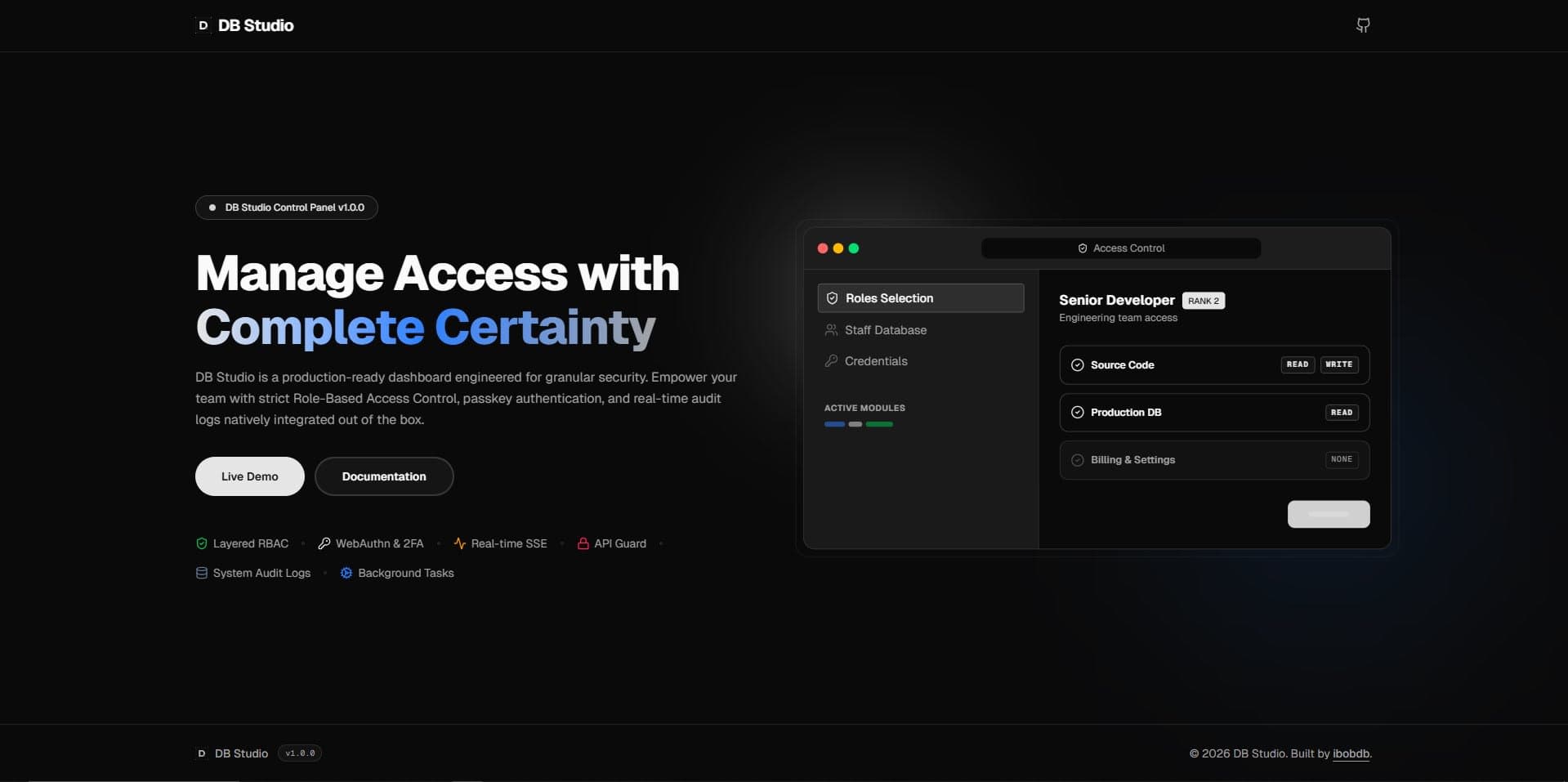
DB Studio (Next.js Enterprise Starter Kit & Orchestration Platform)
1. Problem
Initiating a new production-grade project often requires weeks of "Day Zero" setup: configuring authentication, establishing secure Role-Based Access Control (RBAC), building reusable data tables, and setting up background task queues. Copy-pasting boilerplate code between freelance projects leads to inconsistent developer experience (DX), fragmented security updates, and unmaintainable data-fetching patterns. Furthermore, handling long-running processes (like AI data generation) synchronously causes UI blocking and poor user experience.
2. Solution
Engineered a highly opinionated, full-stack Next.js starter kit designed as a foundational architecture for enterprise applications. It standardizes security via Better Auth, provides dynamic RBAC, and introduces a robust asynchronous task management system capable of receiving webhook callbacks from external workers. I also abstracted complex state management into highly reusable, modular hooks (useTable, useData) to accelerate feature development.
3. Architecture
- Core Framework: Next.js (React)
- Authentication: Better Auth (handling sessions, Passkeys, TOTP)
- UI/Design System: shadcn/ui + Tailwind CSS
- Data Management: Custom generic caching and fetching hooks
- Task Orchestration: Internal async queue + External Webhook Gateway
4. Key Engineering Decisions
- Abstracted Data Hooks (
useTable,useData): Instead of rewritingfetchlogic and loading states for every page, I built central, generic hooks. These hooks natively handle data fetching, pagination, error states, and local caching. This enforces a strict, consistent data-fetching pattern across any future project spawned from this kit. - Asynchronous Task Architecture & Webhook Gateway: Implemented a non-blocking UI pattern for heavy operations (e.g., triggering an external AI model). The API immediately returns a 202 status and adds the operation to an internal
Task List. The system is designed to accept external webhook callbacks from worker scripts once a job is complete. - Context & Callback-Driven State Management: Strictly avoided inefficient client-side polling for task monitoring. Instead, the task and notification state is managed globally via React Context. When an internal task finishes or an external webhook fires, it triggers a direct callback that updates the context state, instantly pushing real-time notifications to the user interface without unnecessary network requests.
- Dynamic & Complex RBAC: Moved away from hardcoded role strings (e.g.,
if (user.role === 'admin')). Implemented a dynamic, granular permission schema that checks specific capabilities at both the API route and UI component levels, making the boilerplate adaptable to any business domain.
5. Challenges
- Designing the
useTableanduseDatahooks to be highly generic (accepting varying data schemas) while maintaining strict TypeScript type safety across the application. - Handling real-time state synchronization for the Task Management and Notification system to ensure users receive immediate feedback when an external webhook resolves a background task.
6. Result
- Reduced "Day Zero" project initiation time from multiple weeks to a matter of hours.
- Drastically improved maintainability across all personal and freelance projects by enforcing standardized architectural patterns and UI components.
- Created a highly scalable foundation where heavy computational tasks are safely offloaded to external workers without freezing the main application backend.
7. Future Improvements
- Abstract the core hooks (
useTable,useData) and RBAC logic into a private npm package (e.g.,@dbstudio/core) so that child projects can pull in architectural updates without manual code merging. - Implement cross-tab state synchronization for the React Context. This ensures that if a user has multiple browser tabs open, a task completion callback triggered in the background perfectly syncs the notification state across all active sessions simultaneously.
- Introduce a specialized audit log export module for strict enterprise compliance reporting.